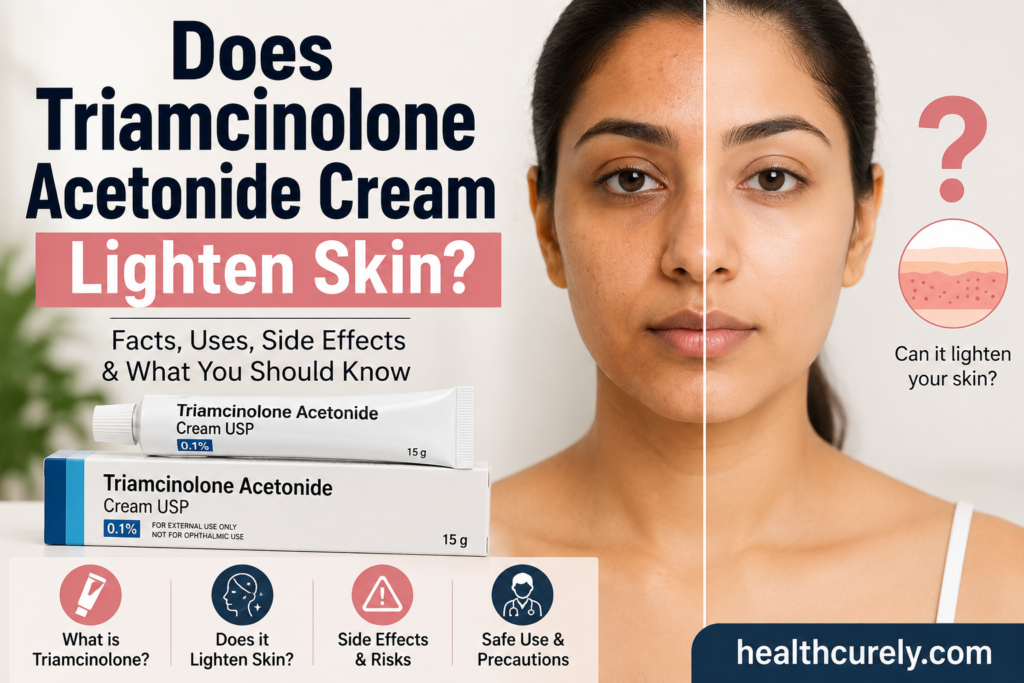

If you have noticed that an area of skin looks lighter after using triamcinolone acetonide cream, you may wonder whether the medication is actually a skin-lightening treatment.
The short answer is no. Triamcinolone acetonide cream is not designed or approved as a skin-lightening cream. It is a topical corticosteroid used to reduce inflammation, redness, itching, and other symptoms associated with certain skin conditions. Official drug labeling also lists hypopigmentation (lighter areas of skin) among possible local adverse reactions.
That distinction is important. A change in skin color after using triamcinolone does not mean that the cream is safely bleaching or brightening the skin. In some circumstances, a lighter appearance can be a side effect of the medication or a change associated with the underlying skin condition.
What Is Triamcinolone Acetonide Cream?
Triamcinolone acetonide is a topical corticosteroid. Corticosteroids are medications that can reduce inflammation and suppress certain immune responses in the skin.
Triamcinolone acetonide cream is available in different strengths, including 0.025%, 0.1%, and 0.5% formulations. The appropriate strength and treatment schedule depend on the condition being treated and other factors.
It may be prescribed for certain inflammatory skin conditions where reducing inflammation and itching is the goal.
It is important to understand that reducing inflammation is different from lightening the natural color of the skin.
Does Triamcinolone Acetonide Cream Lighten Skin?
No, triamcinolone is not a skin-lightening medication.
Triamcinolone acetonide does not belong to the same category as cosmetic or dermatologic ingredients specifically used to address hyperpigmentation.
Its primary purpose is to control inflammation.
However, the medication can sometimes cause hypopigmentation, meaning an area of skin can become lighter. Hypopigmentation is specifically listed among the potential local adverse reactions of topical triamcinolone.
Therefore, if someone notices lighter skin after using triamcinolone, it should not automatically be interpreted as a desirable whitening effect.
Why Can Skin Look Lighter After Using Triamcinolone?
There are several possible explanations for a change in skin color.
1. Hypopigmentation Can Occur
Hypopigmentation means that the affected area has less visible pigment than the surrounding skin.
The official prescribing information for triamcinolone acetonide cream lists hypopigmentation among reported local adverse reactions.
This means that skin becoming lighter can occur as an unwanted effect of topical corticosteroid treatment.
2. The Underlying Skin Condition May Change
Sometimes the medication is being used to treat an inflammatory skin problem that itself affects the appearance of the skin.
As inflammation improves, the color, redness, or texture of the affected area may change.
That does not necessarily mean the steroid is functioning as a skin-whitening agent.
3. Prolonged or Inappropriate Steroid Use Can Affect the Skin
Topical corticosteroids can cause local skin changes, particularly when they are used inappropriately, for extended periods, at higher strengths, or under conditions that increase absorption.
The official labeling lists adverse reactions including skin atrophy (thinning), striae, acneiform eruptions, folliculitis, perioral dermatitis, hypopigmentation, and secondary infection.
For this reason, using triamcinolone simply because you want lighter skin is not a safe approach.
Is Triamcinolone Acetonide a Skin Whitening Cream?
No.
Triamcinolone acetonide cream should not be considered a skin-whitening cream.
The medication is a corticosteroid intended to manage specific inflammatory skin conditions. Its official labeling describes corticosteroids as anti-inflammatory and antipruritic agents rather than skin-lightening products.
Using a prescription corticosteroid for cosmetic skin lightening can expose the skin to unnecessary medication and potential adverse effects.
Can Triamcinolone Remove Dark Spots?
Triamcinolone should not be used as a general treatment for dark spots.
Dark spots can have many different causes, including:
- Acne-related pigmentation
- Sun exposure
- Inflammation
- Melasma
- Skin injuries
- Certain medications
- Hormonal changes
- Underlying skin disorders
Because the cause matters, treatment should be selected based on the specific type of pigmentation.
A topical steroid may sometimes be prescribed as part of treatment for a particular inflammatory condition, but that does not make it an appropriate general-purpose treatment for hyperpigmentation.
What Happens If You Use Triamcinolone on Normal Skin?
Using a topical corticosteroid on normal skin without a medical reason is generally not a good idea.
The potential problem is that you may expose healthy skin to medication without receiving a therapeutic benefit.
Depending on factors such as the strength, duration of use, body location, amount applied, and whether the area is covered, topical corticosteroids can produce local adverse effects. The triamcinolone label includes skin thinning, stretch marks, hypopigmentation, irritation, acne-like eruptions, and other reactions.
Some topical corticosteroids can also be absorbed through the skin in amounts sufficient to produce systemic effects, particularly under certain circumstances.
Can Triamcinolone Make Your Face Lighter?
It is possible for changes in pigmentation to occur when a topical corticosteroid is used on the skin, but this should not be viewed as a safe facial-lightening method.
Facial skin can be particularly sensitive to topical corticosteroids, and inappropriate use can contribute to unwanted skin changes.
If you notice that your face is becoming lighter, thinner, more sensitive, or otherwise different after using triamcinolone, talk with a healthcare professional rather than continuing it for cosmetic purposes.
Can Triamcinolone Cause Permanent Skin Lightening?
The answer depends on the cause of the color change and the individual situation.
A lighter patch could result from hypopigmentation associated with the medication, the underlying skin condition, inflammation, or another cause.
It is therefore not possible to determine from skin color alone whether the change will be temporary or persistent.
If a new light patch develops after using triamcinolone, especially if it is expanding, sharply defined, itchy, painful, or accompanied by other skin changes, a dermatologist can help determine the cause.
Does Triamcinolone Darken or Lighten Skin?
Triamcinolone can be associated with changes in skin pigmentation, including hypopigmentation. It is therefore inaccurate to describe it simply as a cream that either “lightens” or “darkens” everyone’s skin.
The effect depends on the individual, the underlying condition, how the medication is used, and other factors.
The key point is that pigment change is not the therapeutic purpose of triamcinolone.
What Are the Side Effects of Triamcinolone Acetonide Cream?
Topical triamcinolone can cause local side effects.
According to official labeling, reported reactions include:
- Burning
- Itching
- Irritation
- Dryness
- Folliculitis
- Increased hair growth
- Acne-like eruptions
- Hypopigmentation
- Perioral dermatitis
- Allergic contact dermatitis
- Skin softening or maceration
- Secondary infection
- Skin thinning
- Stretch marks
- Miliaria
Not everyone experiences these effects, and the risk can vary according to the treatment circumstances.
Why You Should Not Use Triamcinolone for Skin Whitening
Using triamcinolone specifically to lighten skin is problematic for several reasons.
It Does Not Treat the Actual Cause of Pigmentation
If you have dark patches, the underlying cause needs to be identified.
A corticosteroid may reduce inflammation in some conditions, but it is not a universal treatment for pigmentation.
It Can Cause Unwanted Pigment Changes
Hypopigmentation is a recognized potential adverse reaction of topical triamcinolone.
It Can Thin the Skin
Skin atrophy, or skin thinning, is another recognized local adverse reaction.
Cosmetic Use Can Expose You to Unnecessary Risks
A medication prescribed for an inflammatory skin condition should not be repurposed as a cosmetic bleaching product.
If your goal is to address uneven pigmentation, a dermatologist can help determine a treatment that is appropriate for the specific cause.
What Should You Do If Triamcinolone Made Your Skin Lighter?
If you notice lighter skin after using triamcinolone, do not assume that the medication is safely whitening your skin.
Instead, consider the following:
- Do not increase the amount or frequency on your own.
- Do not use the cream specifically for cosmetic lightening.
- Pay attention to other changes, such as thinning, burning, irritation, acne-like bumps, or stretch marks.
- Contact the healthcare professional who prescribed it if you are concerned about the change.
- Consider dermatological evaluation if the light patch persists, spreads, or has an unusual appearance.
If you have been using a steroid for a longer period, do not make major changes to prescribed treatment without discussing them with the clinician managing your condition.
Is Triamcinolone Safe for Everyone?
There is no single answer because safety depends on the person, the skin condition, the formulation, the strength, the area being treated, and the duration of treatment.
Children require particular caution with topical corticosteroids because systemic absorption can have important consequences. The official labeling warns that chronic corticosteroid therapy can interfere with growth and development in children and recommends limiting treatment to the least amount compatible with an effective regimen.
This is another reason not to use triamcinolone as a cosmetic skin-lightening product.
Frequently Asked Questions
Does triamcinolone acetonide cream permanently lighten skin?
Triamcinolone is not intended to permanently lighten skin. It can cause hypopigmentation as a potential adverse reaction, but a change in pigmentation should not be treated as a cosmetic benefit.
Can I use triamcinolone to whiten my skin?
No. Triamcinolone is a topical corticosteroid, not a skin-whitening treatment. Using it for cosmetic lightening can expose you to unnecessary side effects.
Does triamcinolone remove pigmentation?
It should not be used as a general treatment for pigmentation. Its primary role is reducing inflammation and itching associated with appropriate skin conditions.
Why did my skin become lighter after using triamcinolone?
One possibility is hypopigmentation, which is listed as a potential local adverse reaction. However, the underlying skin condition or another cause could also be responsible.
Can triamcinolone lighten dark patches?
It may alter the appearance of an area by reducing inflammation in a condition for which it was prescribed, but it is not a general-purpose dark-spot or skin-lightening medication.
Is triamcinolone a steroid?
Yes. Triamcinolone acetonide is a topical corticosteroid.
Can triamcinolone thin the skin?
Yes. Skin atrophy, or skin thinning, is listed among the potential local adverse reactions of topical triamcinolone.
The Bottom Line
Does triamcinolone acetonide cream lighten skin?
Not in the sense of being a safe or intended skin-lightening treatment.
Triamcinolone acetonide is a topical corticosteroid used to reduce inflammation and itching. A lighter area of skin can occur as a side effect because hypopigmentation is listed among its possible local adverse reactions.
If you are looking for treatment for dark spots, uneven skin tone, or hyperpigmentation, triamcinolone should not be used simply as a bleaching or whitening cream. The safest approach is to identify the reason for the pigmentation and choose treatment appropriate for that condition with guidance from a qualified healthcare professional.
