
If you have been searching for a Dr Sebi herpes cure, you are likely frustrated. Herpes is a lifelong condition with no approved cure, and mainstream medicine offers management rather than elimination. It is completely understandable that people look elsewhere for hope. Dr Sebi built a large and loyal following precisely because he claimed to offer something doctors could not: a permanent cure through diet and herbs.
But before trying any protocol that promises to cure herpes, you deserve a clear, honest answer about what Dr Sebi actually claimed, what the legal and medical record shows, and what is genuinely known about treating herpes today. That is what this guide covers.
Who Was Dr Sebi?
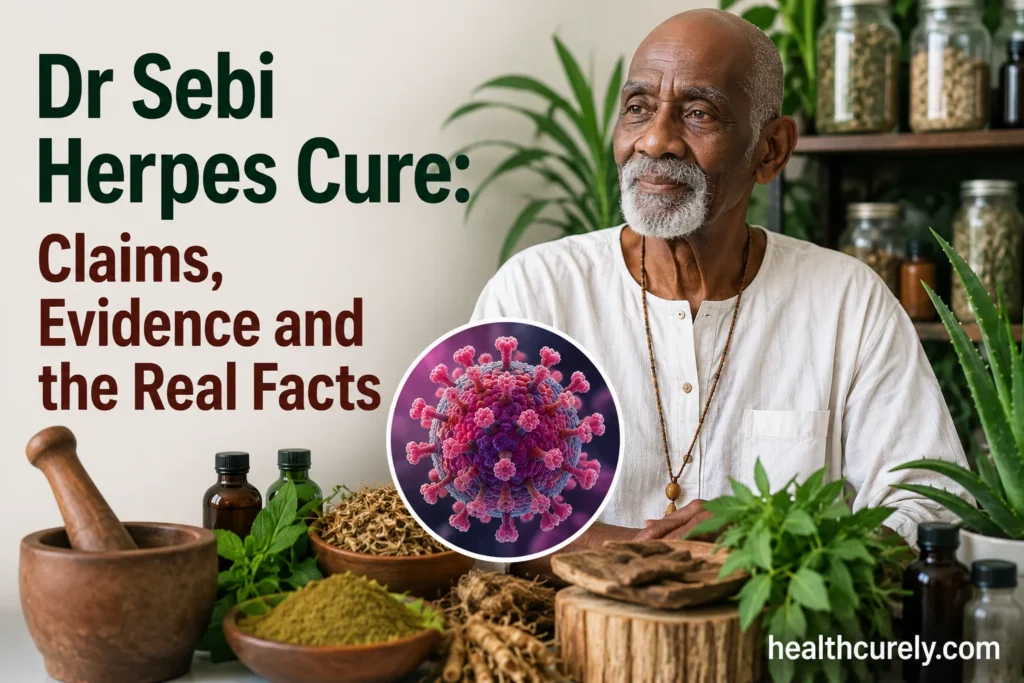
Dr Sebi was the name used by Alfredo Darrington Bowman, a Honduran-born herbalist and self-described healer who lived from 1933 to 2016. He had no formal medical training or recognised scientific qualifications. Despite this, he built a significant following by promoting the idea that virtually all diseases could be cured through an alkaline, plant-based diet combined with proprietary herbal compounds sold through his company, Dr Sebi’s Cell Food.
His central theory was that disease is caused by excess mucus and acidity in the body, and that by eating exclusively alkaline foods and taking his herbal products, the body could cleanse itself and eliminate any illness. His claimed list of curable conditions included herpes, HIV, cancer, diabetes, sickle cell disease, lupus, and blindness.
He attracted celebrity interest and developed a particularly strong following in Black and Latino communities, where mistrust of mainstream medicine has deep historical roots that are entirely legitimate. His message of ancestral, plant-based healing resonated powerfully with many people who had been underserved or harmed by conventional healthcare systems.
What Did Dr Sebi Claim About Herpes?
Dr Sebi claimed that herpes, like all other diseases in his framework, was caused by mucus and acidity in the body. He argued that the herpes virus could not survive in an alkaline cellular environment, and that by following his nutritional protocol and taking specific herbal compounds, the body could eliminate the virus entirely and permanently.
His recommended approach for herpes typically involved:
- Strict adherence to his approved alkaline food list, eliminating all animal products, processed foods, hybrid foods, and anything he classified as acidic
- Taking his proprietary herbal compounds, particularly those marketed for immune support and antiviral activity
- Herbs commonly associated with his herpes protocol included burdock root, elderberry, sarsaparilla, sea moss, and bladderwrack
- Extended fasting in some versions of the protocol
- Complete avoidance of pharmaceutical antivirals, which he described as unnecessary and harmful
His followers reported improvement in their symptoms and some claimed complete resolution of outbreaks. These testimonials are at the heart of his continued popularity online, years after his death in 2016.
What Does the Legal Record Show?
Dr Sebi’s claims attracted legal scrutiny more than once during his lifetime.
The 1987 New York Case
In 1987, the New York State Attorney General took action against Dr Sebi for practising medicine without a licence and making false medical claims, including claims that his products could cure AIDS, herpes, leukaemia, and other serious conditions. The case resulted in an agreed settlement that legally prevented him from making disease treatment claims about his products going forward.
It is worth noting that his supporters often cite a different version of these events, claiming he won the case in court by producing 77 cured patients and that the judge declared him not guilty. Accounts of what exactly happened differ significantly between supporters and legal records, and the agreed settlement outcome is the documented public record.
His Death in 2016
Dr Sebi died in August 2016 in Honduras while in government custody on charges unrelated to his health claims. He was 82 years old. His company, Dr Sebi’s Cell Food, continued to operate after his death and his protocols continue to circulate widely online.
What Does Science Say About the Dr Sebi Herpes Cure?
The honest scientific answer is that there is no clinical evidence that Dr Sebi’s protocol cures herpes. None of his claims have been tested in peer-reviewed clinical trials. No regulatory body, including the FDA, CDC, NIH, or WHO, has validated his approach. Here is why his core theory does not hold up to scientific scrutiny.
Your Body Already Controls Its Own pH
The foundation of Dr Sebi’s entire theory is that food changes the pH of your body and blood, making it more alkaline and therefore inhospitable to disease. This premise is biologically incorrect.
Your body tightly regulates blood pH between 7.35 and 7.45 at all times. This is not a range that varies based on what you eat. Your kidneys and lungs work constantly to maintain this balance. If your blood pH shifted significantly outside this range in either direction, you would be in a life-threatening medical emergency. Food does not meaningfully change blood pH in healthy people. The concept of “alkalising the body” through diet has been thoroughly examined and repeatedly debunked by medical researchers.
Why Herpes Has No Cure: How the Virus Actually Works
Understanding why herpes is so difficult to cure helps explain why no diet or herbal protocol can eliminate it. The herpes simplex virus (HSV) has a unique and sophisticated strategy for surviving in the human body indefinitely.
After initial infection, HSV travels along nerve pathways and establishes what is called a latent infection inside sensory neurons in nerve ganglia. While in this dormant state, the virus is essentially invisible to the immune system and completely out of reach of antiviral drugs, which only work against actively replicating virus. The virus can remain dormant for months or years and then reactivate, causing a new outbreak, without any clear external trigger in some cases.
As the NIH’s National Institute of Allergy and Infectious Diseases states clearly: there is currently no cure for herpes simplex virus. Up to 80% of people aged 14 to 49 in the United States live with HSV-1, and more than 10% live with HSV-2. The virus cannot currently be removed from the nervous system by any known treatment, pharmaceutical or otherwise.
No Herb Has Been Shown to Eliminate Latent HSV
Some of the herbs associated with Dr Sebi’s protocol, such as elderberry and burdock root, do have modest evidence for general immune support or antioxidant activity. A healthy plant-based diet can absolutely support immune function and overall wellbeing.
However, none of these herbs have been shown in rigorous human clinical trials to reach the nerve ganglia where latent HSV resides, suppress viral replication as effectively as pharmaceutical antivirals, or eliminate the virus from the body permanently. General immune support does not equal a cure for a virus that hides inside nerve cells.
Why Do People Report That It Works?
This is one of the most important questions to ask honestly, because dismissing the experiences of people who report improvement does not serve anyone well. There are several real explanations for why people following Dr Sebi’s protocol report fewer or no outbreaks.
Herpes Outbreaks Naturally Decrease Over Time
For many people with HSV, outbreaks become less frequent and less severe over time even without any specific treatment, as the immune system adapts to the virus. Someone who starts a protocol and simultaneously experiences the natural reduction that was going to happen anyway may attribute the improvement to the protocol.
Lifestyle Improvements Have Real Effects
Dr Sebi’s protocol involves eliminating processed foods, refined sugar, alcohol, and eating more whole plant foods. These are genuinely beneficial changes. Poor diet, high stress, fatigue, and immune suppression are all known triggers for herpes outbreaks. Someone who improves their sleep, reduces stress, eats better, and cuts alcohol may well see a significant reduction in outbreak frequency. That is a real outcome, but it reflects the benefits of the lifestyle changes, not the specific herbs or alkaline theory.
Asymptomatic Infection Is Not the Same as Cure
A person can have herpes and experience no symptoms for extended periods, sometimes years. If someone stops having outbreaks while following a protocol, they may genuinely believe they are cured. But the virus remains latent in their nervous system. They can still transmit it to partners even without active sores, and outbreaks can return if circumstances change. Symptom absence is not the same as viral elimination.
The Real Risks of Believing in an Unproven Cure
This is not about dismissing natural healing or Dr Sebi’s cultural significance to the communities he served. It is about being honest about specific, serious risks that come from believing you are cured when you are not.
- Transmission to partners: If you believe you are cured and stop disclosing your HSV status to partners or stop taking precautions, you can unknowingly transmit the virus. This is a direct harm to another person.
- Stopping antivirals for HIV: Some people who find Dr Sebi’s work through herpes claims go on to apply the same logic to HIV. Someone who stops antiretroviral therapy (ART) believing they are cured will experience viral rebound and progressive immune system damage. This is life-threatening.
- Financial exploitation: Dr Sebi’s Cell Food products are expensive. People spending significant money on supplements that cannot deliver what they promise are being harmed financially, often people who can least afford it.
- Delayed diagnosis of other conditions: Someone who believes their symptoms are being managed through herbs may delay seeking medical evaluation for complications that require prompt treatment.
What Treatments Actually Work for Herpes?
While there is no cure for herpes as of 2025, there are well-established, evidence-based treatments that genuinely reduce outbreak frequency, severity, and the risk of transmission to partners.
Antiviral Medications
The three most commonly prescribed antivirals for herpes are aciclovir, valaciclovir, and famciclovir. These medications work by blocking the enzyme the virus needs to replicate. They do not cure the infection or remove the latent virus from nerve cells, but they effectively suppress the virus during active replication.
There are two approaches to antiviral therapy:
- Episodic treatment: Taking antivirals at the first sign of an outbreak to reduce severity and duration. Most effective when started within 24 to 48 hours of symptom onset.
- Suppressive therapy: Taking a lower daily dose continuously to reduce outbreak frequency by up to 70 to 80 percent in people with frequent recurrences, and to significantly reduce the risk of transmission to partners.
Lifestyle Factors That Reduce Outbreaks
These are legitimately helpful and consistent with some of what Dr Sebi recommended, even if the theoretical reasoning behind his approach is flawed:
- Managing stress, which is one of the most common outbreak triggers
- Getting adequate, consistent sleep
- Eating a nutritious diet rich in whole foods and low in processed foods and refined sugar
- Avoiding excessive alcohol consumption
- Staying physically active to support immune function
- Protecting skin from excessive sun exposure, which can trigger oral HSV outbreaks
What Research Is Currently Underway?
The scientific community is actively working toward better herpes treatments and potential functional cures. Current areas of active research include:
- mRNA vaccines: Both Moderna and BioNTech have HSV vaccine candidates in clinical trials as of 2025, using the same mRNA technology platform as the COVID-19 vaccines.
- Gene editing: CRISPR-based approaches that aim to target and disrupt latent HSV DNA inside nerve cells are being explored in early research.
- Nanobody therapy: In 2025, researchers published findings in the journal Nature on a nanobody (a type of mini-antibody) that successfully neutralised both HSV-1 and HSV-2 in laboratory settings by blocking a protein essential for infection.
- New antiviral drug classes: Harvard Medical School researchers published 2025 findings in the journal Cell on a new class of antiviral drugs (helicase-primase inhibitors) that work differently from existing antivirals and may address drug-resistant strains.
A functional cure for herpes may genuinely be achievable within the next decade. The work is real and progressing. That makes it more important, not less, to stay engaged with evidence-based medicine rather than pursuing unproven alternatives that could delay proper care.
Can You Follow a Healthy Diet Alongside Medical Treatment?
Yes, absolutely. A whole-food, plant-rich diet that is low in processed food, refined sugar, and alcohol is genuinely beneficial for immune function and general health. Eating more vegetables, fruits, legumes, and whole grains while reducing ultra-processed food is sound, evidence-based dietary advice that complements any medical treatment for herpes.
The problem with Dr Sebi’s approach is not that plants and vegetables are bad. The problem is the specific claim that this diet cures herpes, that pharmaceutical antivirals should be abandoned, and that testimonials are equivalent to clinical evidence. They are not.
You can eat well and take your antiviral medication. The two are not in conflict.
Conclusion
The Dr Sebi herpes cure is built on a theory of disease that is not supported by biology, and on claims that have never been validated by clinical research. Psyllium husk does not change your blood pH. Herbs cannot reach and eliminate a virus hiding in nerve ganglia. Testimonials, however sincere, are not the same as clinical evidence.
At the same time, the frustration that drives people toward Dr Sebi’s work is real and valid. Herpes carries significant social stigma, antiviral drugs manage rather than cure, and many people feel let down by a medical system that tells them to simply live with a lifelong condition. Those feelings deserve acknowledgement, not dismissal.
The most honest and hopeful thing that can be said is this: a genuine functional cure for herpes is being actively and seriously pursued by well-resourced research teams right now. Vaccine trials, gene editing, and new drug classes are all in active development. Staying engaged with evidence-based care, eating well, managing stress, and working with a doctor you trust gives you the best possible quality of life now and the best chance of benefiting from real advances as they arrive.
Disclaimer: The information provided on Health Curely is intended for educational use only and should not replace professional medical advice, diagnosis, or care. For any health-related issues, always seek guidance from a qualified healthcare professional.