
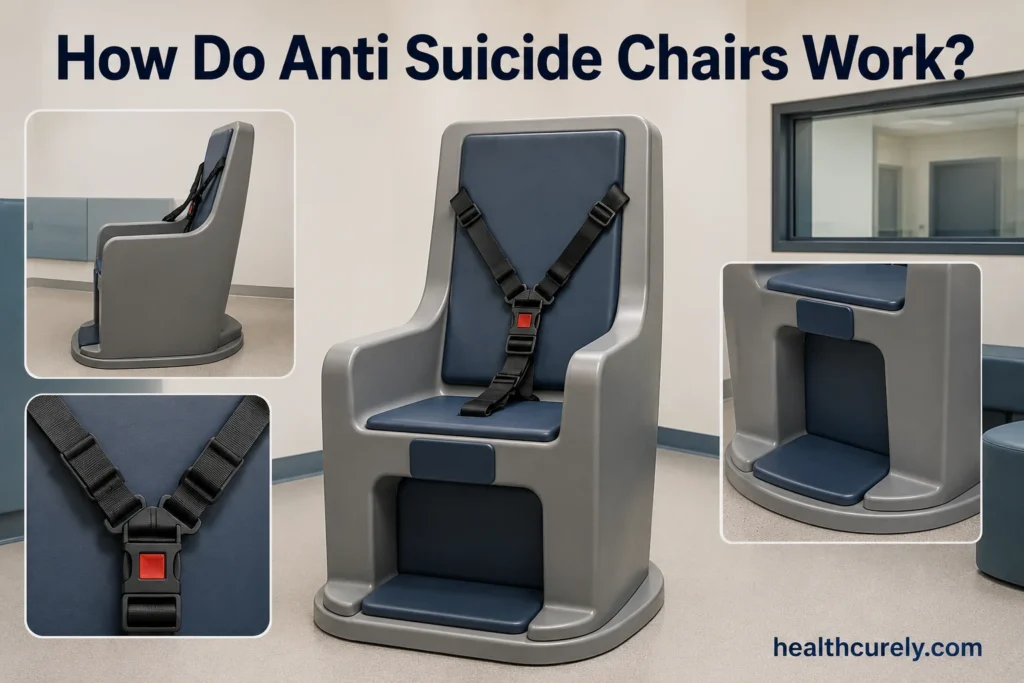

If you have ever wondered how do anti suicide chairs work, you are asking a question that matters. These chairs are not just ordinary furniture with a different name. They are carefully engineered safety tools used in hospitals, psychiatric wards, prisons, and university dormitories. Every curve, material choice, and structural detail serves one purpose: to reduce the risk of self-harm in high-risk environments.
This guide explains exactly how these chairs are designed, what features make them effective, where they are used, and what the research says about their role in broader mental health safety strategies.
What Is an Anti Suicide Chair?
An anti suicide chair, more accurately called a ligature-resistant chair, is a piece of specialist furniture engineered to remove or reduce anchor points that could be used for self-harm. The term “ligature point” refers to any gap, edge, hook, or protrusion where a cord, belt, or fabric strip could be looped and used to support body weight.
Standard chairs are full of these points. Armrest gaps, back rail spaces, screw holes, and removable cushions all create opportunities for harm in vulnerable settings. Ligature-resistant chairs are built from the ground up to eliminate every one of those risks.
According to published safety data, hanging and strangulation account for approximately 75% of suicides among psychiatric inpatients. This is precisely why the physical design of furniture in these settings receives so much careful attention.
How Do Anti Suicide Chairs Work? The Core Principles
Anti suicide chairs work through a combination of design principles that work together as a system. No single feature makes a chair safe. It is the integration of all features together that achieves the result. Here is how each principle works in practice.
1. Elimination of Ligature Points
The primary function of an anti suicide chair is to offer no usable anchor point. This means the chair has no gaps between components where a cord could be threaded, no horizontal rails that could support a noose, and no spaces beneath armrests or between seat and back panels.
Designers achieve this through seamless, continuous construction. The seat, back, and armrests are typically moulded or fused into a single unbroken piece. There is nothing to loop around and nowhere for material to hold weight securely.
2. Smooth, Sloped, and Rounded Surfaces
Any sharp corner or protruding edge is a potential self-harm tool. Anti suicide chairs use fully rounded edges, sloped top rails, and smooth transitions between all surfaces. This slope design means that even if something is placed on the chair, it slides off rather than staying in place.
The sloped back rail is a particularly important detail. On a standard chair, the flat top rail of the backrest is an obvious potential ligature point. On a ligature-resistant chair, this rail is angled downward so that nothing can be tied or hooked onto it effectively.
3. No Removable Parts
Standard chairs have cushions, armrests, feet pads, and screws that can be removed. In a high-risk environment, any removable part becomes a potential tool or weapon. Anti suicide chairs use tamper-resistant fasteners, integrated moulded seating, and fixed components that cannot be separated without specialist tools.
This also includes no hollow interior spaces. Standard upholstered chairs have cavities inside where small objects or contraband can be hidden. Ligature-resistant chairs are solid throughout or use sealed foam cores that offer no internal storage space.
4. Heavy-Duty, Break-Resistant Materials
The materials used in anti suicide chairs are chosen specifically to resist damage, breakage, and dismantling. Common materials include:
- Moulded polyethylene: A dense, impact-resistant plastic that can be formed into seamless shapes without joints or seams.
- Heavy-duty plastic composites: Engineered blends that resist cracking, splintering, and breaking even under repeated stress.
- Encased metal frames: Steel or aluminium structures fully covered in a tamper-proof outer shell that cannot be separated from the frame.
- Anti-microbial finishes: Surfaces treated to resist bacteria, which is essential in healthcare environments where the same chair may be used by many patients.
The goal is that the chair cannot be broken into pieces that could then be used as weapons or sharp implements. If the chair cannot be damaged, it cannot be repurposed for harm.
5. Fixed or Weighted Base
Many anti suicide chairs are either bolted to the floor or designed with a wide, heavily weighted base. This prevents the chair from being lifted, thrown, or used to block doorways. It also means the chair cannot be tipped over and used as a step to reach elevated anchor points such as light fixtures or ventilation grilles.
In psychiatric ward settings specifically, floor-bolted furniture is a common safety standard. In dormitory settings, weighted bases that resist tipping are more common since permanent floor attachment is not always practical.
Where Are Anti Suicide Chairs Used?
Ligature-resistant seating is used in any environment where individuals may be at elevated risk of self-harm and where the physical space must be engineered to reduce that risk. The most common settings include:
Psychiatric Inpatient Units
This is the primary setting where anti suicide chairs are specified. Acute psychiatric wards, crisis stabilisation units, and secure mental health facilities require all furniture, fixtures, and fittings to meet ligature-resistant standards. Chairs, beds, tables, curtain rails, light fixtures, and door hardware are all selected or modified with the same principles in mind.
Correctional Facilities and Prisons
Prisons and detention centres have among the highest rates of self-harm of any institutional environment. Both the UK Ministry of Justice and equivalent bodies in other countries publish formal guidance requiring ligature-resistant design in cells and common areas classified as “safer cells.” Anti suicide chairs are a standard component of this specification.
University Dormitories
Following a rise in awareness about student mental health, many universities have introduced ligature-resistant or anti-suicide chairs in dormitory rooms, especially in institutions that have experienced self-harm incidents. These chairs often have a rocking or curved base that prevents tipping while still looking like ordinary residential furniture, reducing stigma for students living in those rooms.
Emergency Departments and Holding Rooms
Hospital emergency departments frequently have patients waiting who are in acute mental health crisis. Waiting areas and assessment rooms in these departments are increasingly being fitted with ligature-resistant furniture, including anti suicide chairs, as a precautionary standard.
Design Evolution: From Clinical to Therapeutic
For many years, ligature-resistant furniture was immediately recognisable as institutional. The hard surfaces, clinical colours, and obvious safety modifications made psychiatric wards and secure facilities feel punishing rather than healing. Research has increasingly shown that an environment which feels hostile or dehumanising can work against recovery outcomes.
Modern anti suicide chair design has moved significantly toward what designers call therapeutic aesthetics. Manufacturers now produce chairs that meet every ligature-resistant standard while using warm colour palettes, familiar domestic proportions, softer-looking moulded surfaces, and designs that would not look out of place in a hotel lobby or university common room.
This shift is important. When a chair looks like an ordinary chair, it does not signal danger or stigma to the person sitting in it. A calmer, more normalised environment actively supports mental health treatment goals rather than working against them.
What Anti Suicide Chairs Cannot Do
It is important to be honest about the limits of ligature-resistant furniture. These chairs are one layer of a broader safety system. They are not, and were never designed to be, a complete solution on their own.
- A determined individual will look for anchor points beyond the chair itself, including door handles, plumbing fixtures, or window frames.
- Physical design measures must be paired with adequate staffing, regular observation, therapeutic support, and crisis intervention training.
- Anti suicide chairs reduce opportunity. They do not address the underlying distress that creates risk in the first place.
- In open settings like dormitories, the chair is only one piece of furniture in a room that may contain many other objects.
Mental health professionals and facility designers consistently emphasise that environmental safety measures are most effective as part of a whole-system approach that includes strong clinical care, visible staff presence, and a culture that treats patients with dignity.
Conclusion
Anti suicide chairs work through a precise combination of seamless construction, sloped surfaces, tamper-resistant materials, and fixed components that together remove every practical ligature point from the furniture. They are a vital piece of environmental safety design used in psychiatric wards, prisons, hospitals, and increasingly in university settings.
Understanding how these chairs work helps facilities make better procurement decisions, helps families understand what safety measures exist in care environments, and helps anyone involved in mental health advocacy appreciate the role that physical design plays alongside clinical support.
If you are researching furniture for a healthcare or care facility, always look for products that meet current ligature-resistant standards, carry relevant safety certifications, and are backed by documented design specifications rather than marketing claims alone.
If you or someone you know is struggling, please reach out to a mental health professional or contact a crisis helpline in your country. Help is available.
Disclaimer: The information provided on Health Curely is intended for educational use only and should not replace professional medical advice, diagnosis, or care. For any health-related issues, always seek guidance from a qualified healthcare professional.